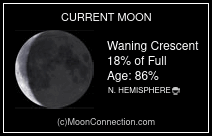
"The glacier knocks in the cupboard, The desert sighs in the bed, And the crack in the teacup opens A lane to the land of the dead."

-W.H. Auden

Showing posts with label neighborhood. Show all posts

Thursday, January 28, 2016

The Fringes


Going through my files tonight, I came across this crude map I'd drawn of  my immediate neighborhood, back in 2008. It was obviously meant to be somewhat humorous, but it was also meant to illustrate a particular problem at the time.

What happened was, I had found a set of knives (marked in red text, above) on the ground outside my bedroom window. This was disturbing, but it was not possible to tell if someone had been lurking outside the window for some nefarious purpose, or if they had been hidden there after a crime, or they had been flung there by someone needing to get rid of them fast (for instance, a parolee who'd just seen a cop).

We took the knives to the police station, and while the cops seemed unimpressed, it was still worrying. I drew this map illustrating how all three scenarios had potential, and posted it to an internet forum so my online friends could give it a look. (For the record, most people thought scenario 3  - someone  running from the Forlorn Intersection had flung them there - was the correct one and since nothing ever came of it, I assume they were right.)

Looking back on it now, though, what I see is a psychogeographical map of a fringe area. Fringe areas are of particular interest to me, being transitional places where one thing becomes another. Fringe areas are often overlooked, even though they are around us all the time. Entrance ways and exits, alleys, the outskirts of towns. Fringe areas are also frequently places where crime is more likely to occur - though I hasten to add, my family never personally experienced any crime there.

There were a few transitions occurring in the scope of this map. First (and most noticeable in person) was the petering out of the gentrified neighborhood of restored houses into unrestored houses and then, across the tracks (off the map) into dusty slums. There was an overlapping of social backgrounds and economic status. Then there is the blending of traditionally racially identified areas. Many different types of people came together in this street.

Studying the map (and also from memory) the true fringe area must have been the Forlorn Intersection. I knew quite a few very nice people who lived on the other side, but that intersection - just a drab little road, really - was always the place where things went down.

It's interesting to note that right on the edge stood the convent house - A Poor Clare monastery, to be exact. Quiet, peaceful, shining like a beacon on prayer nights. No one ever, ever messed with the Poor Clares. Regardless of status, they were there for everyone.

All these years later, it occurs to me that there should be many more things marked on the map. Like the house with stained-glass windows, or the silent hedges. I feel lucky that some of these things are captured in the early part of this blog (which was kind of the point, really). But there are other things that aren't so easy to capture. Dust and silt. Humming streetlights.The church carillon that rang every day at 8, 12 and 5. These are little things that make up the secret nature of a place.

One white hot summer day, my friend Arturo was riding past on his bicycle and we stopped to talk. He waved a copy of the local newspaper. "Did you hear? About the creature?" he asked, pointing at the front page picture of the Cuero chupacabra. We both thought it was fascinating, but agreed that sometimes things were better if we never learned the whole truth.

If I could, I would put that on the map, too.

(apologies - I ended up posting this yesterday before it was finished. (long story))

Monday, February 16, 2015

Tom's Van


 In the darkest parts of winter, I always remember Tom.

It was some years ago now, when we lived in the little Victorian house at the end of the lane. Tom and Debbie were our neighbors. They were nice neighbors, as neighbors go; though usually we only saw them in passing.

I was lonely a lot in that house, and as lonely people tend to do, I kept to myself. Especially in winter, when it was dark and cold. I'd huddle in my room with the heat on, drinking endless cups of tea and listening to Turn On The Bright Lights. Outside, the neighbors would go about their business, coming and going or chatting in the street, their breath rising in clouds of steam. This much I could see from my window at the side of the house, in the gaps between the blinds. I learned the sound of all the neighborhood cars as they made their rounds, and watched their taillights disappear into the night. Somehow their red glow brought a sort of comfort.

Tom had a little blue van, I can't recall any more whether it was a Ford or a Dodge, though I don't suppose it really matters. The van was an older model and made a distinctive rattling sound, like a bag full of glass bottles when you take it to the recycling plant. I always knew when Tom arrived home in the evening or drove to the corner store to buy gas. The rattle was a dead giveaway.

It's hard to hide when you have a noisy car.

While Tom and Debbie had seemed like a solid couple, in January of that year Debbie made a surprise move - she threw Tom out of the house and by the next weekend had moved a new man into his place. If it was a surprise to me, it must have been even more of a surprise to Tom.

 "Oh, him, he drank too much" said Debbie, by way of explanation. Maybe it was true, maybe it wasn't. The new man smiled like the cat that ate the canary. I didn't like him at all.

Meanwhile, late at night, I could hear the distinctive sound of Tom's van as he roamed the neighborhood, driving past the place where he had so recently lived. He would come from different directions, winding casually toward his old house. He'd creep down the maze of darkened side streets, then turn as if he were merely passing on his way to somewhere else. Perhaps he was trying to be surreptitious. For all the good it did.

In my lonely room with the yellow lights and the tea and the gloomy music, I felt sympathy. Not that it was any of my business, and not that I approved of stalking, but I understood it must have been hard to find yourself cast out and replaced in a matter of days. It's never pleasant to be unwanted. How does a person find closure? I can't say for sure that I wouldn't have done the same.

The next few nights, as the rattling van approached from afar, I began to imagine the sound (which I knew very well was probably a busted catalytic converter) was really what it sounded like - a bunch of hidden liquor bottles stowed in the back, evidence of the secret drinking that got him into this mess. Driving in circles, a cacophony of shame. I'd wave at him from my window as he passed by, a gesture of fellow-feeling from a fellow outcast. Yeah, it was probably the catalytic converter, but truth be told, I'll never know for sure. I only know the rattle made me feel less alone.

It wasn't long before Tom gave it up and moved on, maybe a week at most. The new man was settled in to stay. His truck made a strange whistling sound that became familiar but was never comforting.
After that, I'd only hear the sound of Tom's van by chance, if we happened to be driving on the same street in town, and only until the next inspection came up - that catalytic converter would have to be replaced.

I never saw Tom again after that, and Debbie eventually fled after getting on the wrong side of the Mexican Mafia. I never saw her, or the new man again either. Some new neighbors moved in, and another chapter came to an end on our little street.

I'm still lonely, though. I suppose that's one thing that will never change.